
Here is the conclusion most pin buyers reach too late: enamel is not always the premium choice. When a design depends on gradients, photos, shading or tiny color areas, enamel forces it into flat zones separated by metal lines, and the pin loses what made the artwork special. Printed lapel pins keep it.
This guide explains when printed lapel pins beat enamel, how UV printing works on metal, and how to order a printed pin that looks the way your artwork does. For the wider overview of styles, see our custom lapel pins buyer guide.
What Are Printed Lapel Pins?
Printed lapel pins carry artwork printed directly onto the metal instead of filled with enamel. UV printing reproduces full color, gradients, photos and fine detail exactly as designed, and it can print onto raised 3D surfaces too. They suit complex logos, illustrations and photographic designs that enamel cannot show without heavy simplification.
The process uses UV-curable inks applied by a printer that works much like a desktop inkjet, with the ink cured by ultraviolet light as it lands. Because the color is printed rather than poured, it does not need metal walls to hold it in place.
Printed vs Enamel Pins: Where Each One Wins
| Factor | Printed (UV) pins | Soft enamel pins | Hard enamel pins |
|---|---|---|---|
| Gradients and shading | Yes, reproduced as designed | No; flat color areas | No; flat color areas |
| Photos | Yes | No | No |
| Very small color areas | Shown clearly | Limited by metal line spacing | Limited by metal line spacing |
| Raised metal lines | Not required | Yes, color sits below the lines | Yes, polished flat with the color |
| Surface feel | Smooth printed surface; epoxy coating available | Textured, recessed color | Smooth, flat, polished |
| Color on 3D relief | Yes, UV can print on raised surfaces | Not practical | Not practical |
| Best for | Illustrations, photos, complex logos, art reproductions | Bold logos and bright budget-friendly runs | Premium logos with solid colors |
If your design is a bold logo with a few solid colors, enamel is still an excellent choice; our hard enamel vs soft enamel comparison will help you choose between the two.

Five Designs That Should Be Printed, Not Enameled
- Photos and portraits. Memorial pins, pet portraits and team photos need continuous tones.
- Illustrations and digital paintings. Artist pins, book covers and game art depend on shading.
- Logos with gradients. Many modern brand marks fade from one color to another.
- Maps, skylines and landscapes. Sunsets, skies and water lose their character in flat enamel.
- Tiny text in color. Small colored areas that metal lines cannot separate show clearly in print.
Printing on 3D: Color Where Paint Cannot Go
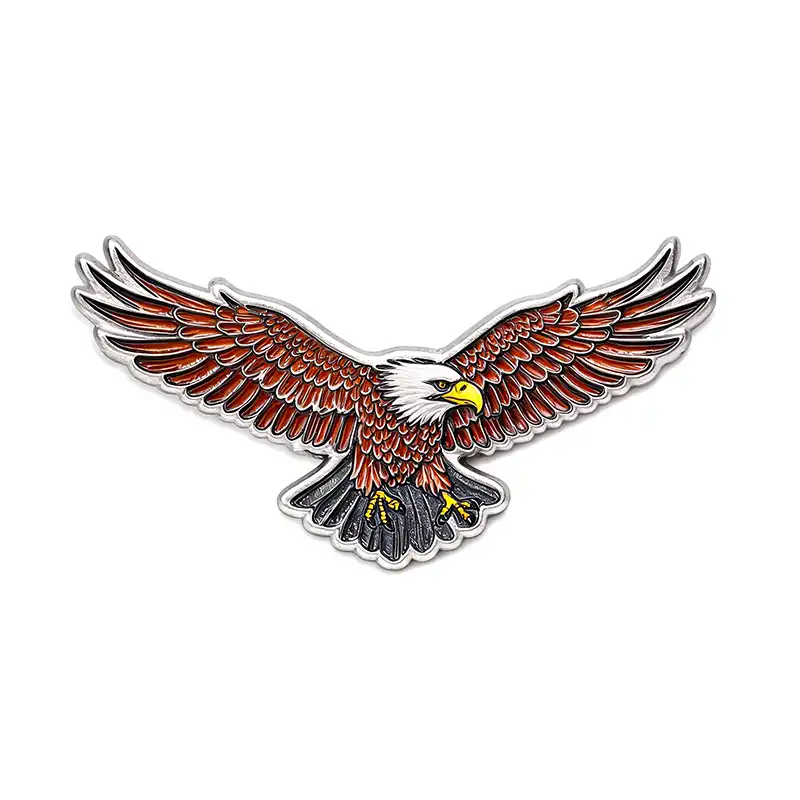
A sculpted 3D lapel pin has raised, curved surfaces. Liquid enamel or paint runs off those curves, so traditionally they were left as bare plated metal. UV printing changes that: the color is printed onto the raised relief, so a sculpted eagle, mascot or face can carry full color and depth at the same time.
How a Printed Lapel Pin Is Made
- Artwork and proof. You send your design; we prepare a free digital proof showing the pin shape, size, plating and printed area.
- Mold and base. The pin shape is created from a mold, like other metal pins, and the base is formed and polished.
- Plating. The metal is plated in the finish you choose.
- UV printing. The artwork is printed onto the pin surface and cured with UV light.
- Finishing and backing. An epoxy coating can be added for extra surface protection, and the pin post receives the backing you choose.
- Inspection and packing. Pins are checked and packed, then shipped by international express carriers such as UPS, FedEx or DHL.
Because print skips the enamel color-filling steps, printed pins can also move through production faster. If you have a tight event date, look at UV printed rushed pins; tell us your deadline and we will confirm the schedule before you order.
Artwork Tips for Sharper Printed Pins
| Tip | Why it matters |
|---|---|
| Send the highest-resolution file you have | Print reproduces what is in the file, including blur |
| Use vector for the outline and text | The pin shape is cut from the outline; clean edges give a clean shape |
| Keep key text large enough to read at pin size | A pin is small; very fine text can be hard to read even if it prints |
| Add a metal border or keyline | A plated rim frames the print and protects its edge |
| Tell us the colors that must match | We confirm critical colors on the proof |
For file preparation in depth, read how to prepare vector artwork for custom pin production.
Options That Pair Well With Printed Pins
Printed pins use the same plating and backing choices as other pins. On our lapel pin options page you will find antique and shiny platings, two-tone plating and dyed metal, plus butterfly, rubber, deluxe and magnetic backings. Epoxy coating and UV printed color are listed among the upgrades, and printed areas can be combined with enamel on the same pin when part of the design is a bold logo and part is artwork.
Pins in general have a long history as lapel accessories, but printing has widened what they can show. There is no minimum order: you can start with 1 piece. Browse all custom lapel pins or send your design through our contact page.
Summary
Printed lapel pins win whenever the artwork depends on gradients, photos, shading or tiny color areas. UV printing reproduces the design directly on the metal and can even color raised 3D relief. Enamel remains the better fit for bold, solid-color logos. Send a high-resolution file, approve the free digital proof, and choose rushed UV printing for tight deadlines. Orders start at 1 piece with no MOQ.
Printed Lapel Pin FAQ
Are printed lapel pins lower quality than enamel pins?
Not for the right design. Enamel is ideal for bold solid colors; printing is the better choice for gradients, photos and fine color detail that enamel cannot reproduce.
Can a printed pin include a photo?
Yes. UV printing reproduces full color and photographic artwork directly on the metal. Send the highest-resolution file you have.
Doesn’t a printed surface wear off quickly?
An epoxy coating can be added over the print for extra surface protection, and a raised metal border helps protect the edges.
Can you print on a 3D pin?
Yes. UV printing can print color directly onto raised 3D surfaces, where liquid enamel or paint would run off.
Are printed pins faster to make?
Printing skips the enamel color-filling steps, so printed pins can move through production faster. Tell us your deadline and we will confirm the schedule.


