




Coast Guard Rescue Challenge Coins: How the Service Honors the Crews Who Run Toward the Storm
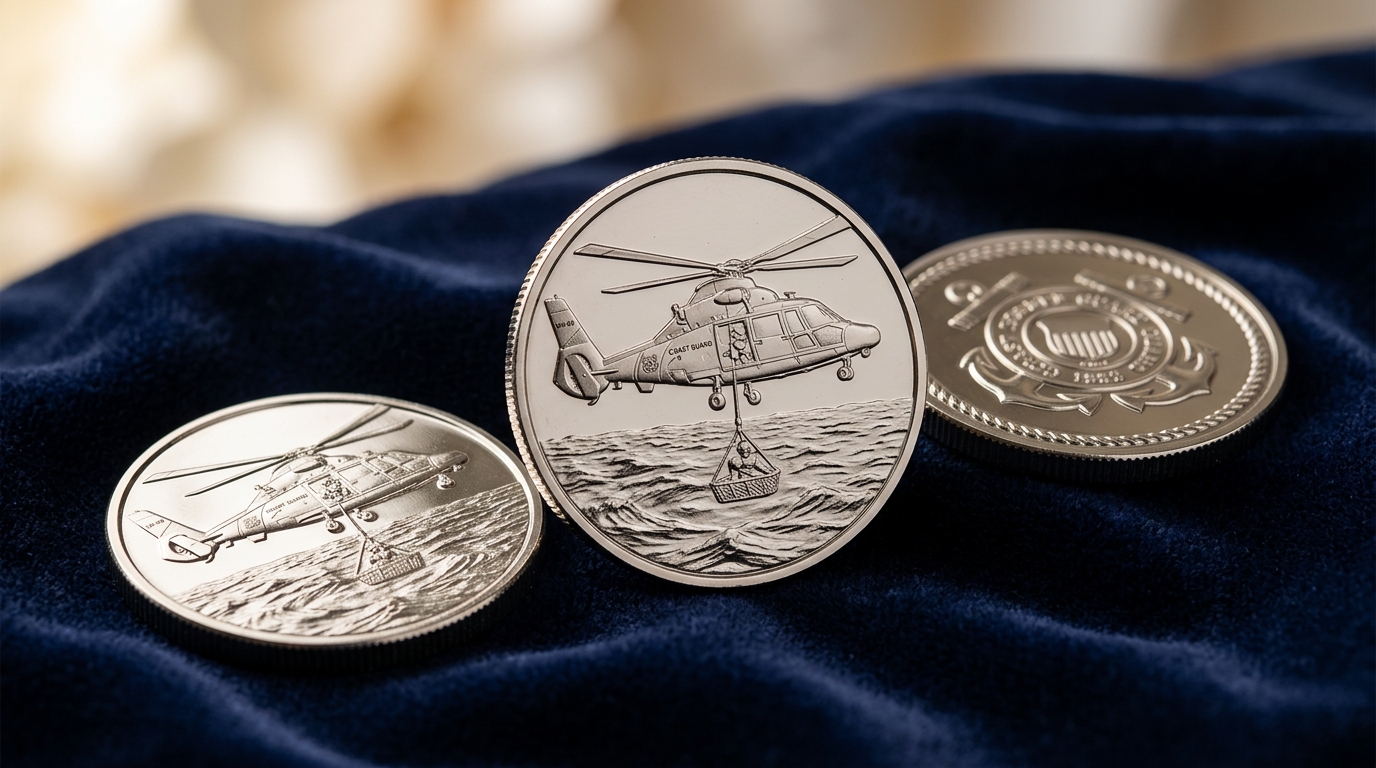
Coast guard rescue challenge coins exist for one reason: to thank the people who strap into a helicopter or a rescue boat when everyone else is heading inland. They are physical thank-yous for crews who fly into 80-knot winds, drag swimmers off foundering hulls, and tow disabled freighters back to port. When a cutter crew saves a life, hands a life ring to a survivor in 12-foot seas, or recovers a missing diver off a wreck, the rescue coin becomes the artifact that says “we were there, we did that, and we remember.”
This guide is written for the procurement officers, command chiefs, auxiliary flotilla leaders, and family members who order these coins. It covers what to put on the face, which metal and finish survives saltwater and sun, how to size an order across a district, and how to present the coin so the moment lands.
Why Coast Guard Rescue Operations Are Different From Every Other Mission
The Coast Guard runs 11 statutory missions under one roof — only one of them is search and rescue. Yet SAR is the mission the public sees, the mission the press covers, and the mission that puts USCG crews on national television more than all the other ten combined. According to Coast Guard official statistics, the service saved over 19,000 lives in a single recent fiscal year and assisted another 11,000+ people. Those numbers translate into thousands of cases where a single rescue swimmer, a single aircrew, or a single boat crew earned the right to be remembered.
That is the difference between a rescue coin and a unit coin. A unit coin says “I belong to Station Boston.” A rescue coin says “I was in the basket, in the water, or on the line that day.” The coin has to be specific enough to make the event legible. A generic “U.S. Coast Guard” face will not feel earned. The face has to carry the airframe, the hull number, the sector, the date, or the operation name.
Anatomy of a Coast Guard Rescue Coin That Earns Its Place

The coins that work best in this category share five design elements. If you skip any one of them, the coin becomes forgettable.
1. The mission motif, not the service seal.
The Coast Guard seal is correct but generic. A rescue coin needs a mission motif. The most-used motifs are:
– An MH-65 Dolphin helicopter on a hoist, basket lowered, line taut
– A 45-foot Response Boat-Medium (RB-M) on a wave face
– A rescue swimmer in profile, fins and dive helmet visible
– A surfman in a beach-station hat with belt-thrown heaving line
– A barrel (life ring / life float) lashed to a painter line
2. The hull or tail number.
Real crews want their airframe or boat. CG-6501 is not decoration; it is identity. Put it under the aircraft on the face or as a serial-style engraving on the rim.
3. The sector or station name.
Coast Guard sectors and stations are territorial identities. Sector Humboldt Bay, Station Cape Disappointment, Air Station Elizabeth City — these names belong on the coin.
4. A bottom banner with the operation or year.
“SAREX 2026,” “TRAINING CYCLE 24-B,” “ICE STORM ’24 RESPONSE” — give the coin a date. Without a date, the coin reads like a souvenir. With a date, it reads like a record.
5. Side edge work.
This is where most coins fail. A rescue coin is meant to be held, not pinned to a board. Reeded (vertical-line) edges or rope-twist edges give the fingers something to feel. A diamond-cut edge is sharper and reads as more formal but is harder on the pocket.
Plating and Finish: What Actually Survives Saltwater and Sun
Most challenge coins live in display cases. Coast guard rescue challenge coins live in pockets, in flight suits, and in glove boxes. That changes the finish requirements.
| Finish | Corrosion Resistance | Salt Spray Tolerance | Best For |
|—|—|—|—|
| Antique brass | Good | 48-72 hrs salt spray | Replica ship coins, centenary coins |
| Polished nickel | Very good | 100+ hrs | High-traffic award coins carried daily |
| Polished gold (24k-like) | Excellent | 200+ hrs salt spray | Senior officer presentation sets |
| Antique copper / bronze | Good | 48-72 hrs | Historical and lineage coins |
| Black nickel with gold accents | Very good | 100+ hrs | Tactical / SWAT-style recognition |
For rescue operations specifically, polished nickel or polished gold is the safest choice. Antique brass and copper will tone within months in a saltwater environment, and the crews will love them because they tone — but if you want the coin to look identical five years later, plated gold over a nickel undercoating is the answer.
The enamel matters as much as the metal. Hard enamel (cloisonné) is non-negotiable for rescue coins. The face will be set down on wet benches, dropped on tarmac, and thumbed daily. Soft enamel catches dirt in the recessed metal lines and starts to look tired within a season.
Sizing an Order Across a District
The Coast Guard does not run on small numbers. A single Air Station might have 400-600 personnel in rotor-wing, fixed-wing, and maintenance roles. A sector can be 1,000+. The procurement officer has to plan for:
– 1 coin per aircrew / boat crew member (the people who actually flew or sailed)
– 1 coin per support member in the rescue shop (communications, electronics, mechanics) at half-rate
– 1-2 presentation coins for the commanding officer and executive officer, in velvet boxes
– 5-10 coins kept by the command for visiting dignitaries, allied officers, and late-cycle awards
A reasonable first run for a single Air Station rescue centennial is 250-400 coins. For a sector-wide SAR exercise coin, plan for 800-1,200 coins across all subordinate units.
Presentation: When a Coin Becomes a Moment

A challenge coin presented in an envelope becomes a piece of mail. A challenge coin presented in a ceremony becomes a story. The Coast Guard has a long tradition of structured coin presentations tied to specific events:
– End-of-tour coin — given by the commanding officer at a member’s departure ceremony
– Mission completion coin — handed after a verified rescue or a multi-day SAR case
– Award coin — paired with a formal letter of commendation or a CG medal
– Memorial coin — issued in small numbers to remember a lost member or boat
For each, the presentation ritual matters. The standard form: the recipient stands, the presenter holds the coin in the right hand, reads the citation, hands the coin over, and the recipient acknowledges with a handshake. The coin is then displayed, not pocketed immediately. That small rule — “you do not pocket it in front of me” — is what turns a metal disc into an event.
Common Mistakes When Ordering Coast Guard Rescue Challenge Coins
After reviewing hundreds of rescue-coin orders across districts and flotillas, the same avoidable problems show up again and again:
Mistake 1: Putting the service seal as the dominant motif.
The USCG seal is correct but generic. Every Coast Guard unit uses the same seal. Use a mission motif instead — the airframe, the boat, the swimmer, or the operation.
Mistake 2: Omitting the hull or tail number.
A crew without their hull number is a crew without their identity. The number has to be on the face or the rim, in raised metal, not in print.
Mistake 3: Using soft enamel to save cost.
Soft enamel is fine for a morale coin that lives in a display case. For a rescue coin that lives in a flight-suit pocket, hard enamel is the only correct finish.
Mistake 4: Failing to include the bottom banner date.
Without a date, the coin is timeless — and that is the problem. A rescue coin is supposed to mark a specific event.
Mistake 5: Ordering 1,000 coins “just in case.”
Coins are dated artifacts. An over-order sits in a drawer and gets handed out for the wrong reasons. Order for the operation, the centennial, or the season — and re-order when the next cycle starts.
How to Work with a Custom Coin Manufacturer
A Coast Guard procurement officer has three viable paths to a finished coin:
1. Local trophy shop. Best for sub-100-coin emergency orders. Limited design capability and limited metal options. Expect 4-6 weeks.
2. Mid-tier online custom coin vendor. Best for 100-500-coin orders with standard designs. Expect 3-4 weeks plus shipping.
3. Direct-factory custom coin maker. Best for 500+ coins, complex designs, and tight timelines. Expect 2-3 weeks, with revision cycles included.
The factory-direct path is the right answer for SAR exercise coins and centennial coins, because the artwork is doing real work — the MH-65 silhouette has to be right, the sector crest has to be reproduced accurately, the hull number has to be spelled correctly. The factory’s design team will redraw your sketch into vector format, mock up three options, and revise until the coin matches your intent.
FAQs About Coast Guard Rescue Challenge Coins
Q: How much does a custom coast guard rescue challenge coin cost?
For hard-enamel, 50mm, antique or polished metal, expect $3.50-$6.50 per coin at 300-coin quantity, $2.80-$4.20 at 1,000-coin quantity, before mold fees. Mold fees are one-time, typically $80-$200 depending on complexity, and are amortized across the order.
Q: What is the standard size for a coast guard rescue challenge coin?
The standard is 1.75 inches (44mm) for carry coins and 2.0 inches (50mm) for presentation coins. Smaller than 1.5 inches looks like a token; larger than 2.0 inches is hard to carry in a flight-suit pocket.
Q: How long does production take?
Two to three weeks for production after artwork approval, plus 3-5 business days for shipping to a US address. Total: roughly three to four weeks from final design to delivery.
Q: Can I include a classified or operationally sensitive detail on the coin?
You can, but you should not. Operational details — exact grid coordinates, classified unit names, sensitive equipment designations — should stay out of any coin that will be carried in public or given to family members. The coin should celebrate the people and the outcome, not the method.
Q: Are coast guard rescue challenge coins appropriate to give to civilian survivors?
It depends on protocol. Some commands give a coin to a survivor as a token of connection. Most do not — the coin is an internal recognition object, and a survivor receiving it can be misread. A letter and a USCG patch are the safer external gesture.
Conclusion
Coast guard rescue challenge coins are not generic recognition objects. They are dated, mission-specific, operationally grounded artifacts that say “we were there.” The coins that last in collections — that get handed down, that show up at reunions 20 years later — are the ones that get five things right: a mission motif instead of a seal, the hull or tail number, the sector name, a bottom banner with a date, and side-edge work that earns the fingers.
A coin ordered this way, presented in a moment of recognition, becomes the physical memory of a real rescue. That is what makes it worth ordering at all.
—
[Customize your coast guard rescue challenge coins at MGM Crafts](https://mgmcrafts.com/shop/products/challenge-coins/custom-challenge-coins/) — free design, factory-direct pricing, and a 4-week turnaround from artwork to delivery. For sourcing help, email sales@mgmcrafts.com.
—
