




Table of Contents
Graduation Challenge Coins: Designs, Ideas, and Etiquette
Graduation challenge coins are custom-minted metal coins given to mark the completion of a degree, training program, or service academy. They function as a portable diploma — a tactile, lifelong reminder of an achievement that a paper certificate cannot match. Service academies like West Point and the U.S. Naval Academy have used them for decades, and in the last ten years the tradition has spread to high schools, universities, police academies, and corporate leadership programs. This guide covers who gives them, the design choices that work best, gifting etiquette, and how to order in time for the ceremony.

What Are Graduation Challenge Coins?
A graduation challenge coin is a custom 1.5″ to 2″ metal coin produced specifically for a graduating class, program, or individual graduate. The design typically carries the school crest or program seal on one side and a class-specific element — year, motto, cohort number, or graduate’s name — on the reverse.
Unlike a generic souvenir coin, a graduation coin is presented in a formal moment: a coining ceremony, a final-night dinner, or by a mentor handshake on the parade ground. That presentation is what turns a piece of metal into a keepsake people carry for the rest of their lives.
Who Gives Graduation Challenge Coins?
The tradition started in the U.S. military and has expanded outward. Today the most common givers fall into five groups:
- Service academies — West Point, U.S. Naval Academy, Air Force Academy, Coast Guard Academy, and the Merchant Marine Academy each issue distinct graduation coins to every cadet or midshipman.
- Police, fire, and EMS academies — Recruit classes receive coins on the day they graduate from the academy, often presented by the chief or commissioner.
- Universities and colleges — ROTC programs, honors colleges, fraternities, sororities, and specific degree programs (especially MBA and executive education cohorts) issue coins.
- High schools — IB programs, JROTC units, valedictorian recognition, and athletic captains.
- Corporate training and leadership programs — Companies like Microsoft, Boeing, and Lockheed Martin give coins to graduates of internal leadership academies and onboarding cohorts.
The common thread: the coin is given by the institution, not bought by the graduate. That distinction is what gives the coin its weight as a symbol.
Design Elements That Work for Graduation Coins
The strongest graduation coin designs balance institutional identity with a personal touch for the specific class. The table below summarizes the elements that appear on most successful designs and what each one signals.
| Element | Where It Goes | What It Communicates |
|---|---|---|
| School crest or seal | Obverse (front) center | Institutional identity, prestige |
| Graduation year | Reverse, large or bordered | Class identity, cohort bond |
| Motto or Latin phrase | Encircling either face | Values the institution stands for |
| Program name | Reverse or rim | Specific cohort identity (MBA, ROTC, IB) |
| Mascot or symbolic figure | Reverse center | School pride and recognizability |
| Diamond-cut or rope edge | Coin rim | Premium feel, military tradition |
| Engraved name or rank | Reverse, optional | Personalization for individual graduates |
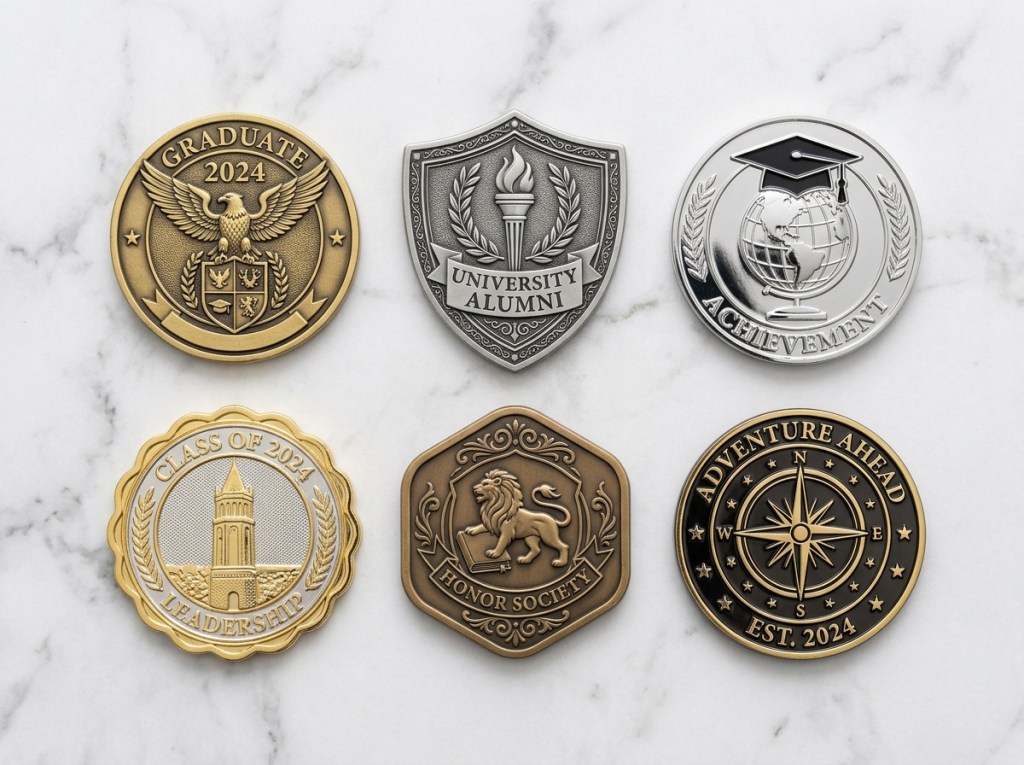
Two design tips worth following. First, keep typography readable at 1.75″. A motto in 6-point script looks beautiful on a mock-up but disappears on the finished coin. Second, leave breathing room around the school crest. The visual weight of the crest is what carries the design, and crowding it with text reads as cluttered rather than rich.
Popular Materials and Finishes
Choice of metal and finish affects both the look and the price. For most graduation coin orders, the decision comes down to three combinations:
1. Antique gold or antique silver — The most popular finish for service academies and traditional universities. The recessed areas hold a darker patina that makes the relief details stand out. Best for crests, mottoes, and any design that depends on fine detail. 2. Polished gold or chrome — A high-shine mirror finish, brighter and more modern. Reads as celebratory rather than solemn. Good for cohort coins, athletics, and corporate training programs. 3. Dual plating (gold + silver) — Two finishes on the same coin, usually with the crest in one tone and the lettering or border in the other. Adds depth without adding much cost; popular for premium MBA and executive education cohorts.
Soft enamel fills are the standard color option and cost the least. Hard enamel is smoother to the touch and gives a jewelry-like finish, but adds roughly 15-25% to the per-coin cost. For most graduation orders under 200 pieces, soft enamel is the right call — the saved budget is better spent on a velvet presentation box.
Gifting Etiquette: Coining the Graduate
The presentation matters as much as the coin. A coin handed over in a paper envelope is just a souvenir; a coin handed over with the right gesture becomes a lifelong memento. The traditional method, borrowed from the military, is the coin handshake: the presenter palms the coin and transfers it during a handshake, often with eye contact and a short sentence (“Well done. You earned this.”).
Three etiquette points to keep in mind:
- One presenter per graduate. The coin gains weight when it comes from a specific person — the program director, the commanding officer, the principal — not from a generic “the institution.”
- Brief, specific words. Long speeches dilute the moment. A single sentence acknowledging what the graduate accomplished is enough.
- No price tags, no packaging clutter. If you include a presentation case, keep it minimal — black velvet or a simple wood box. Branded cardboard with marketing copy on the lid undermines the formality.
If you are planning a coin ceremony for the first time, ordering enough coins for every graduate plus 10% extras for late additions and replacement requests is standard practice.
How to Order Graduation Challenge Coins
Most schools and programs that order coins for the first time underestimate the lead time. A standard graduation coin order takes 4-6 weeks from artwork approval to delivery, and 8-10 weeks if you want a custom shape, dual plating, or rush proof revisions. Start the conversation with a manufacturer at least 12 weeks before the ceremony date.
The ordering process at most reputable manufacturers follows the same sequence:
1. Submit your design brief — Send the school crest (vector preferred), the class year, and any text you want included. A rough sketch is fine; you do not need to provide finished artwork. 2. Receive a free digital proof — The manufacturer’s art team will mock up the coin in 2-3 business days. Expect to go through 2-3 revision rounds. 3. Approve the proof and pay a deposit — Most manufacturers ask for 50% on order, balance on shipment. 4. Production runs 3-4 weeks — The dies are cut, coins struck, plating and enamel applied, and each coin inspected. 5. Shipping and delivery — Air freight from Asia takes 5-7 days; domestic finishing options are available for an additional fee.
For a class of 100 graduates with a 1.75″ antique gold coin, soft enamel, and a velvet box per coin, the all-in cost typically lands between $4.50 and $7.50 per coin. Bulk orders above 250 units drop the per-unit price by 20-30%. You can request a free quote directly through the custom challenge coins page — submit your crest and class size and most quotes come back within one business day.

Common Mistakes to Avoid
A handful of mistakes show up over and over in first-time graduation coin orders. Knowing them upfront saves a reprint cycle:
- Forgetting the year. A coin without the graduation year loses its cohort meaning the moment a new class graduates. Always include the year.
- Using a low-resolution crest. Logos pulled from a school website are usually 72 DPI and will look blurry on a die. Request the vector file from your communications office.
- Picking a custom shape too early. Round coins cost less and look more traditional. Save custom shapes for milestone anniversaries (50th, 100th class) where the extra cost is justified.
- Skipping the proof revisions. The free proof rounds are the cheapest place to catch typos. A misspelled motto on 200 struck coins is an expensive reprint.
- Cutting it close on lead time. Rush orders cost 30-50% more and limit your finish options. Twelve weeks ahead of the ceremony is the safe window.
Graduation Challenge Coins FAQ
Q: Can the graduate’s name be engraved on the coin? A: Yes. Most manufacturers offer rear-side laser engraving for $2-4 per coin. Provide a name list as a spreadsheet and the engraving is done after striking.
Q: What is the minimum order quantity? A: Most factories have a 50-coin minimum because of the cost of cutting the die. Smaller orders are possible but the per-coin cost climbs sharply.
Q: Do graduation coins have a standard size? A: No, but 1.75″ diameter is the most common. Service academies often go larger (2″ or 2.5″) for a more substantial feel.
Q: Can we add the school colors to the coin? A: Yes — soft or hard enamel fills can match any Pantone color. Provide the Pantone codes with your artwork.
Q: Are challenge coins tax-deductible for the institution? A: In most cases, yes, when given as part of an official recognition program. Confirm with your finance office, as treatment varies by institution type.
Q: How long do the finishes last on a graduation coin? A: A properly plated and lacquered coin holds its finish for 20-30 years of normal handling. Antique finishes are the most forgiving — small scratches blend into the existing patina. Polished gold or chrome shows wear faster but can be re-polished with a soft cloth.
After the Ceremony: Display and Care
Most graduates do one of three things with their coin: carry it in a pocket, display it on a desk, or store it in a drawer. The presentation matters because it shapes which path the graduate chooses.
A coin handed over in a flimsy plastic capsule almost always ends up in a drawer. A coin handed over in a black velvet box with a hinged lid usually ends up on a shelf or desk. A coin presented loose, with the expectation that the graduate will carry it, often becomes a pocket carry for decades — which is the original military intent of the tradition.
If you want to encourage display rather than carry, include a small acrylic stand with each coin. Stands cost roughly $0.50 in bulk and turn the coin into a visible reminder of the achievement. For carry coins, a small leather pouch or felt sleeve prevents the coin from scratching keys and phones in the same pocket. Either way, treat the packaging as part of the gift, not a shipping container.
Final Thoughts
Graduation challenge coins turn a one-day ceremony into a lifelong artifact, and they cost a fraction of the engraved plaques or class rings that schools used to default to. The design choices that work best are also the simplest — a clear crest, the year, a short motto, and a finish that suits the program’s tone. Start the process at least twelve weeks before the ceremony, order 10% over your class size, and put as much thought into the presentation as into the coin itself. Done well, the coin will outlast every other gift the graduate receives that day.
For schools, academies, and programs planning their first coin run, the team at MGMCrafts handles the full process — from crest vectorization to presentation boxes. Reach out at sales@mgmcrafts.com for a quote.
