




Table of Contents
Sports team challenge coins are custom-minted metal coins that mark a roster, a season, or a championship. They serve the same role in a locker room that a class ring serves on a college campus: a tangible artifact of belonging that outlasts the season, the jersey number, and sometimes the player’s career. Professional franchises, college athletic programs, high school teams, and recreational leagues have all adopted them, and the tradition is now spreading into esports, amateur hockey, and competitive youth sports. This guide covers what makes a sports coin work, the design choices teams get right, the moments when the coin gets presented, and how to time an order so it lands before the season opener or championship game.
What Are Sports Team Challenge Coins?
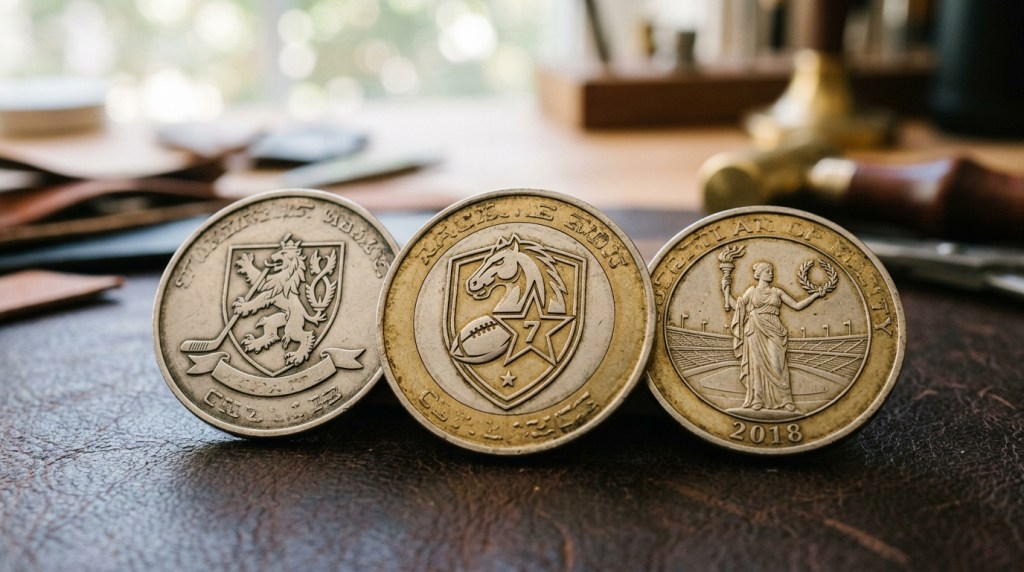
A sports team challenge coin is a 1.5″ to 2.5″ custom metal coin produced for a specific team, season, or championship. The design typically carries the team logo on one side and a season-specific element on the other — the year, the conference, a championship result, the player’s jersey number, or a motto that captures the team’s identity for that year.
Unlike a participation medal or a championship ring, a challenge coin is handed to a player in a moment, not given at a podium in front of a crowd. The handoff is the ceremony. The coin is the keepsake. That distinction is what makes the object feel personal rather than institutional.
Who Uses Sports Team Challenge Coins?
The market for sports team challenge coins is much wider than most people assume. The most common buyers fall into six groups:
- Professional franchises — NFL, NBA, MLB, NHL, MLS, and WNBA teams issue coins for season ticket holders, premium suites, alumni players, and locker-room captains.
- College athletic programs — Power 5 and Division I programs order coins for team captains, senior day, bowl game travel, and post-season locker room gifts.
- High school teams — Varsity football, basketball, baseball, soccer, and lacrosse programs in every state now order coins for seniors and captains.
- Youth and travel leagues — Competitive hockey, AAU basketball, club soccer, and travel baseball order coins for championship runs, tournament wins, and end-of-season banquets.
- Esports and competitive gaming — Collegiate esports programs, professional orgs, and tournament organizers issue coins to winning rosters and MVP players.
- Recreational leagues and pickup teams — Adult softball, basketball leagues, fantasy football leagues, and intramural sports use coins as a low-cost way to mark a championship or a season.
The common thread: the coin is given by the team to the player, not the other way around. The giver matters as much as the design.
Why Teams Are Switching from Medals and Rings to Challenge Coins
The shift from medals and rings to coins is driven by three practical advantages that matter to athletic departments and team managers working with real budgets.
Cost per unit. A championship ring can run $200 to $1,500 per player. A high-quality challenge coin runs $3 to $8 per player for the same team. A program that hands out 80 senior gifts on senior day can spend $1,000 on coins instead of $20,000 on rings, and the senior keeps an object they actually carry with them.
Distribution flexibility. Rings ship weeks after the season ends. Medals are presented at a single ceremony. Coins can be ordered before the season, presented throughout the year, and given in private moments — a captain handoff in the locker room, a post-game handoff to the offensive line, a “challenge coin” moment with a recruit on their official visit. The coin is portable in a way that rings and medals are not.
Trade and display culture. Players trade coins. They sit in lockers, on dashboards, on keychains, and on display shelves in team facilities. A medal goes in a drawer. A ring goes in a safe. A coin gets seen every day, and the team logo gets seen with it.
Standard Sizes, Shapes, and Finishes
A sports team coin has to read as a sports team coin the moment it hits the table. That means the right combination of size, shape, and finish for the sport.
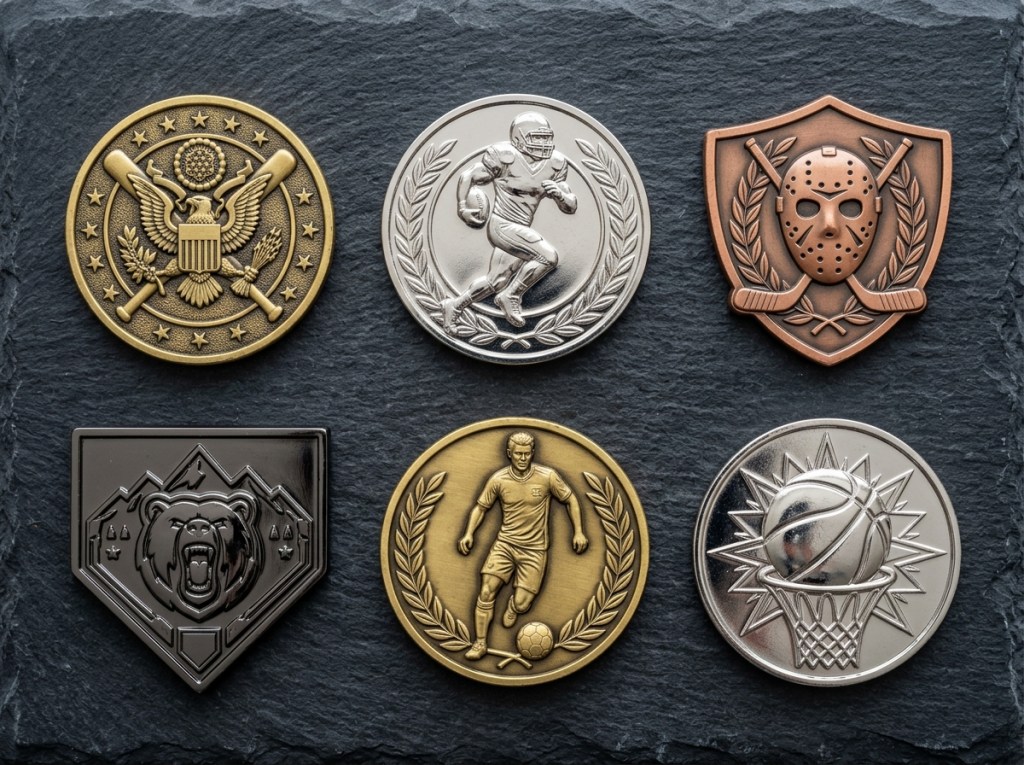
| Sport | Typical size | Common shape | Most popular finish | |——-|————–|————–|———————| | Football | 1.75″ to 2″ | Round, oval, or shield | Antique gold or dual-plated | | Baseball | 1.5″ to 1.75″ | Round with home-plate edge cut | Polished silver or antique copper | | Basketball | 1.75″ to 2″ | Round | Antique gold or polished gold | | Hockey | 1.75″ to 2″ | Puck-style oval or round | Polished silver or pewter | | Soccer | 1.5″ to 1.75″ | Round | Antique silver or dual-plated | | Esports | 1.5″ to 1.75″ | Hex, shield, or round | Black nickel or matte black with color print | | Lacrosse | 1.75″ | Round or shield | Antique silver | | Wrestling | 1.75″ | Round | Antique gold |
The shape choice matters more than most buyers realize. A baseball coin with a home-plate edge cut is unmistakable the moment it lands on a table. A hockey coin shaped like a puck silhouette is the same. A round coin is the safe default, but a sport-specific silhouette makes the object instantly readable from across the room.
What Goes on the Front and Back of a Sports Coin
The strongest designs use both sides of the coin to tell two different parts of the team’s story.
The front (the team side) typically carries:
- Team logo or wordmark
- Team colors baked into the plating or enamel
- Mascot or primary symbol
- The city, state, or program name
The back (the season or moment side) typically carries:
- Season year or championship year
- Conference, division, or tournament name
- A team motto or rallying cry
- A roster, captain list, or “presented to” line for individual coins
- A record (undefeated season, conference championship, state title)
- A small detail the team earned that year (rivalry win, comeback season, first playoff appearance)
The most memorable coins are the ones where the back side tells a story only the team knows. A coach who orders 80 identical coins with the team logo on the front and a 12-0 record on the back has created an object that 80 players will keep forever. A coach who orders 80 individually engraved coins with each player’s name and number has created 80 separate objects that no one will trade.
The Three Handoff Moments Teams Use
A coin only becomes a keepsake when it is presented in a moment. Three handoff patterns are the most common across sports programs at every level.
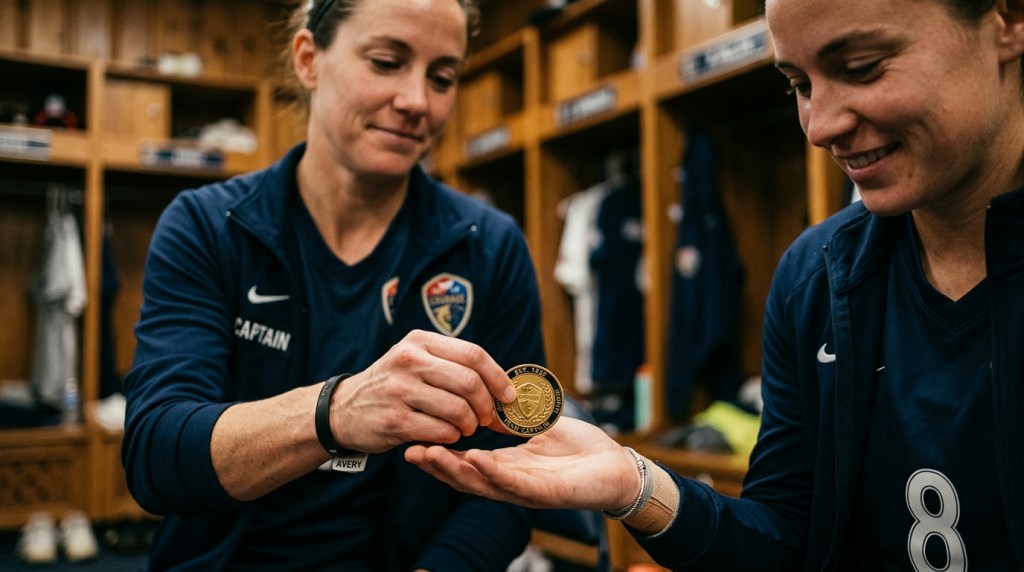
The captain’s coin. A coach presents a single distinct coin to the team captain at the start of the season. The captain carries it for the year, then returns it to the coach at the end-of-season banquet. The captain’s coin is usually larger, heavier, or more decorated than the rest. The pattern is borrowed from military command coins and works in any team sport.
The senior handoff. At senior day or the final home game, each senior receives a coin in a private moment with the coach, often at midfield or in the locker room after the game. The senior coin is the one the player keeps forever. It usually carries the player’s name, number, and a small detail from their career (captain, four-year starter, school record holder).
The post-championship coin. After winning a conference, state, or national championship, the team receives a championship coin at the celebration. The championship coin is usually the most elaborate design of the year and is presented to every player, coach, and support staff member.
Most programs run all three. The captain’s coin sets the tone for the season. The senior handoff marks the end of careers. The championship coin marks the moment the team won.
Design Choices That Make a Sports Coin Work
Five design decisions separate a coin players keep from a coin players leave in a hotel room.
Match the metal to the colors. A school whose colors are black and gold should not get a polished silver coin. The plating sets the entire tone. Antique gold for gold programs, polished silver for silver programs, dual-plated for two-color programs, black nickel for dark or stealth designs.
Put the year on the coin. A coin without a year becomes anonymous the moment the next season starts. The year is what makes a 2018 championship coin different from a 2022 championship coin. Make it large enough to read across a room.
Engrave the details that matter. A 12-0 record. A state title. A 50th anniversary. The name of a retiring coach. A 1,000-point career. Details that no one outside the program will understand are the details that the players carry forever.
Skip the QR code. A sports coin is not a marketing object. It is a keepsake. A QR code on a coin a player carries for the rest of their life is a distraction. The team’s logo, the year, and the details are enough.
Order a few extras. Players lose coins. Coaches lose coins. Parents ask for coins years later when a player goes pro. Order 10% to 15% more than the roster size and label the extras in a separate envelope for the coach to hold back.
Common Mistakes When Ordering Sports Coins
Five mistakes come up year after year, and they are all avoidable.
Ordering too early. A coin ordered in March for a November season opener can sit in a warehouse for eight months. The longer the lead time, the more likely the design gets re-rendered and the year gets stale. Order four to six weeks before the first handoff moment.
Skipping the proof. A digital proof on a phone screen is not the same as a printed proof in hand. Every serious challenge coin vendor will mail a printed proof or send a high-resolution PDF that shows the enamel fills, the metal finish, and the edge details. Approve the proof in writing. The proof is the only artifact that protects the design intent.
Choosing the cheapest metal. A thin, lightweight coin feels like a souvenir. A 3mm to 4mm thick coin with real weight feels like a keepsake. The price difference is usually $1 to $2 per coin. Spend the extra $1.
Designing the front to look like a logo store. A coin that looks like a screen-printed t-shirt with a flat logo is not a coin. A coin has depth, texture, and metalwork. Use raised relief, recessed text, sandblasted backgrounds, and 3D elements. The medium is the message.
Forgetting the packaging. A coin in a plastic bag is a giveaway. A coin in a velvet pouch, an acrylic case, or a custom gift box is a gift. The packaging is what makes the handoff moment feel ceremonial. Budget $1 to $3 per coin for a velvet pouch or display case.
How Many Coins to Order
A simple rule covers most situations. Order the number of players on the active roster, plus 10 to 15 extras, plus a few for the coach and support staff. For senior day coins, order one per senior plus five extras. For championship coins, order one per player on the championship roster plus 10% extras.
For a high school varsity football program with 60 players, that is roughly 70 to 75 coins. For a college basketball team with 15 players on scholarship and 5 walk-ons, that is 25 to 30 coins. For a youth hockey team with 18 players, that is 22 to 25 coins.
The extras are not waste. They are the inventory the coach will need three years from now when a former player asks “do you still have my senior coin? My kid wants to see it.”
When to Order in the Sports Calendar
Timing matters more than the design. A coin that arrives after the season is over is a coin that lives in a drawer.
| Moment | Order lead time | Ship to | First handoff | |——–|——————|———|—————-| | Pre-season captain’s coin | 4 to 6 weeks before the opener | Coach’s office | First home game | | Senior day | 4 to 6 weeks before the senior day game | Coach’s office | Senior day game | | Conference championship | 2 to 3 weeks before the championship game | Athletic department | Championship game | | State championship | 2 to 3 weeks before the title game | Athletic department | Title game | | Post-season banquet | 4 to 6 weeks before the banquet | Coach’s office | Banquet | | End-of-season gifts | 3 to 4 weeks before the last game | Coach’s office | Final home game |
The most common timing mistake is the post-season banquet. Programs that order banquet coins in early fall have them in hand by mid-season. Programs that order in late fall scramble to find a rush vendor and pay double.
How Sports Coins Fit With Rings, Banners, and Awards
A challenge coin does not replace a championship ring. It complements it. The traditional awards ladder for a championship team is still rings for the players, banners for the gym, and trophies for the case. The coin is the new layer that fills in the moments when a ring is too expensive and a trophy is too impersonal.
A coach who gives a captain’s coin in week one, a senior coin in week ten, and a championship coin in week fourteen has built a year of moments. A coach who gives one trophy at the end of the year has built one moment. The coin is the medium for the moments that the trophy cannot reach.
For programs that already invest in custom medals and team awards, the natural next step is to look at how custom challenge coins are designed for sports use cases specifically. The design language is the same, but the size, weight, and edge details get tuned for the sport and the team.
Conclusion
Sports team challenge coins are not a new idea, but the spread from professional franchises to high school and youth programs is recent. The reason is simple: a coin is the only award a program can give to every player on the roster, in a private moment, that the player will actually carry with them for the rest of their life. Pick the right size, shape, and finish for the sport, put the year and the details that matter on the back, hand the coin over in a moment that feels like something, and the coin does the rest. Order early enough to be in hand for the first handoff, order 10% more than the roster size, and the next season is going to feel different in the locker room from day one.
