


Table of Contents
How Custom Challenge Coins Are Used in Mental Health Awareness Campaigns
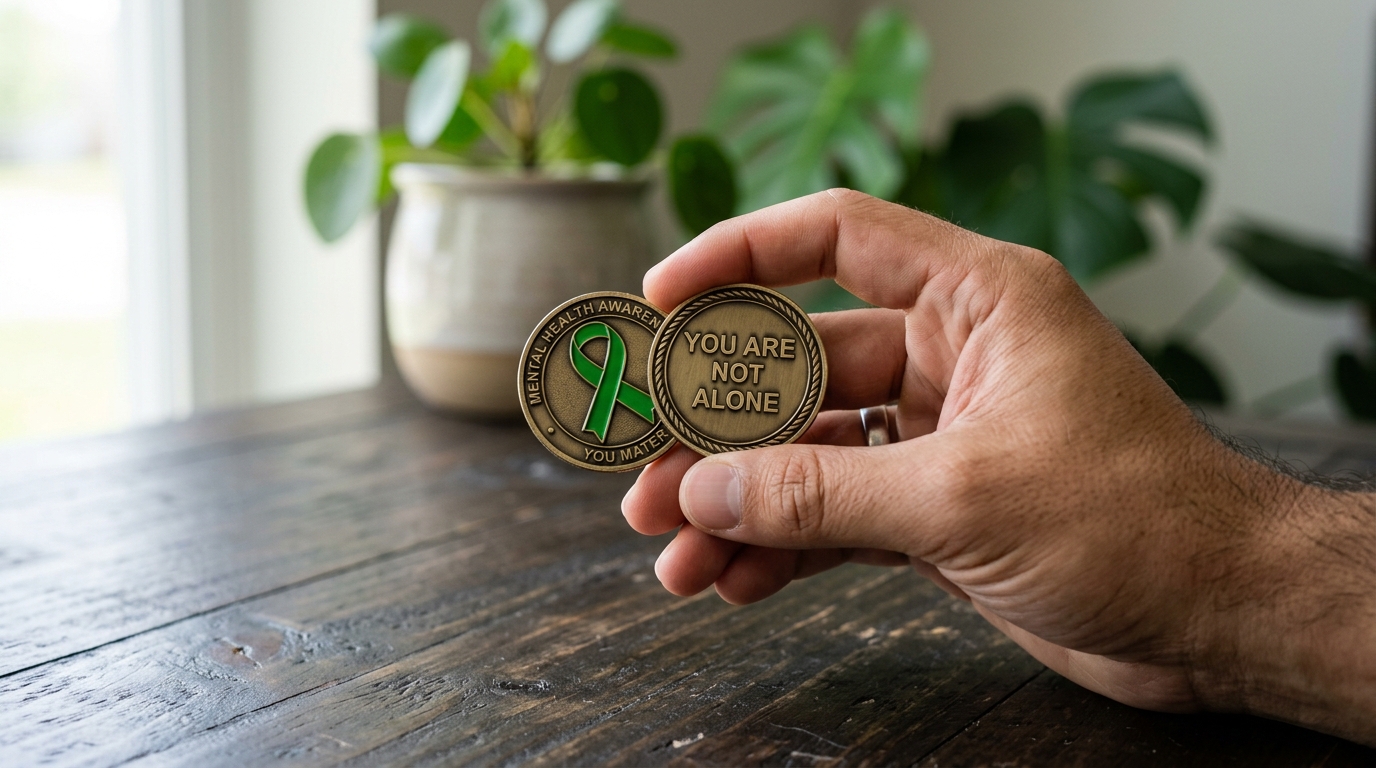
When we talk about awareness campaigns for mental health, we usually picture ribbons, wristbands, and social media hashtags. But over the last few years, custom challenge coins have quietly become one of the most powerful tools for mental health advocacy. They are tangible, they last for decades, and they spark the kind of face-to-face conversation that digital awareness simply cannot replicate.
This guide explains how mental health awareness challenge coins are being used today, what design choices make them work, and how to order coins that genuinely support your cause without feeling gimmicky or exploitative.
Why Tangible Symbols Matter in Mental Health Awareness
Awareness ribbons and digital campaigns serve a purpose, but they have limits. A ribbon on a lapel is small and easy to miss. A hashtag disappears in a day. A challenge coin, by contrast, is something people carry in a pocket, set on a desk, or hand to someone who needs to know they are not alone.
For mental health specifically, the physical object matters because:
- Carrying it is a private act of solidarity. Not everyone is ready to broadcast their struggle. A coin stays visible only to the people the carrier chooses to show it to.
- It anchors an emotional moment. Receiving a coin during a recovery milestone, a memorial, or a first-responder debrief turns an abstract “we see you” into something you can hold.
- It travels further than a post. One coin can pass through twenty hands in a year. A social post reaches one feed.
The Main Mental Health Causes Custom Coins Support
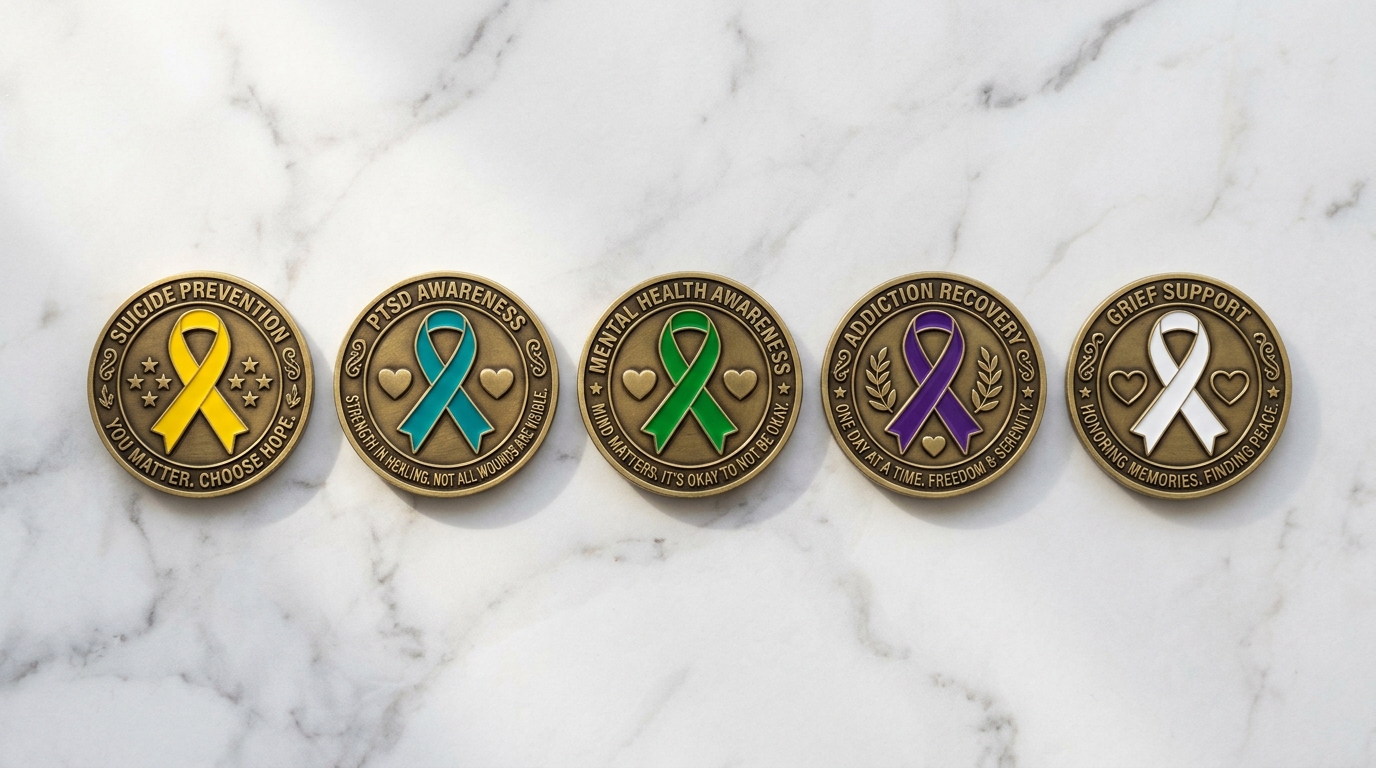
Suicide prevention and postvention
Yellow ribbon coins, semicolon coins (the semicolon project), and coins with crisis hotline numbers (988 in the US, Samaritans in the UK) are the most-requested designs. They serve three roles: a quiet identifier for someone in crisis, a memorial keepsake for a lost loved one, and a fundraising tool for prevention programs.
PTSD and first responder support
Police, fire, EMS, and military units have a long tradition of challenge coins. Increasingly, those coins are being redesigned to address PTSD, moral injury, and peer support. Common elements include Thin Line flag variants (silver for corrections, blue for police, red for fire), the word “Always” in honor of fallen comrades, and crisis line numbers on the back.
Depression, anxiety, and general mental health
Green is the international color for mental health awareness. Coins in this space often feature simple, hopeful imagery (a sun breaking through clouds, a tree, a single growing plant) and the wearer’s choice of affirmation on the reverse.
Addiction recovery and sober living
Recovery programs use coins to mark sobriety milestones (30 days, 90 days, 1 year, 5 years) the way AA uses chips, but with the added permanence of metal. Veterans’ recovery programs in particular have moved from generic AA chips to custom recovery coins because they are harder to lose and feel more personal.
Grief and bereavement
Memorial coins for those lost to suicide, overdose, or mental health crisis are an entire subcategory. They are often given to family members at a memorial service and carried as a private remembrance object.
How Organizations Actually Use These Coins
Custom mental health awareness coins serve five practical purposes:
- Fundraising. Sold at events, in online stores, or included in donor thank-you packages. Because they are priced accessibly ($5 to $15 at retail for a basic coin), they convert well as add-on donations.
- Volunteer and peer-recognizer recognition. Crisis hotline volunteers, peer support specialists, and team leads receive coins to mark training completion or service anniversaries.
- Memorial distribution. Given to attendees of a memorial walk, a remembrance service, or a suicide postvention gathering. They replace or complement printed programs and candles.
- Corporate wellness gifts. Mental health days off, EAP enrollments, and wellness program completions are increasingly marked with a coin rather than a certificate.
- Conversation starters. When someone notices a coin on a desk or in a hand, it opens a door to “what is that for?” which is precisely the conversation mental health advocates want to start.
Design Choices That Make a Mental Health Coin Work
Color and plating
Use the cause’s recognized color in the enamel fill. Gold, silver, antique brass, and rose gold platings all work, but avoid plating the entire coin in a high-gloss mirror finish if the cause is somber. Matte, antique, or sandblasted finishes read more respectfully.
Front imagery
Keep it specific. A generic ribbon reads as “awareness product.” A hand passing a coin to another hand, a semicolon woven into a heartbeat line, or a lighthouse in fog tells a story.
Reverse text
This is where most organizations fail. The back of a mental health coin should carry the organization’s name and contact, the crisis hotline number for the relevant region, and a short affirmation or year (not a marketing slogan).
Edge and 3D
Coins for active carriers (first responders, peer supporters) should have reeded or rope edges for grip. Coins meant to sit on a desk (memorial, recognition) can have smooth or sculpted edges. 3D relief works well for symbolic objects (hands, ribbons, lighthouses) but adds cost and 5 to 7 days of production time.
Size and weight
The most common size is 1.75 inch (44mm), large enough to feel substantial and small enough to fit in a pocket. For memorial coins, 1.5 inch is the traditional size. For recognition coins meant to be displayed, 2 inch or 2.25 inch works.
How to Order Custom Mental Health Awareness Coins
The ordering process is the same as any custom challenge coin, with three extra considerations:
- Proof carefully. Mental health organizations frequently need to approve designs through a board, a clinical review, or a survivor advisory panel. Build 7 to 10 extra days into your timeline for revisions.
- Choose a manufacturer experienced with delicate work. Soft enamel, photo-etched details, and small text are common in this category. A manufacturer that specializes in bulk corporate coins may not deliver the quality you need.
- Order in small batches first. A first run of 50 to 100 coins is normal for a nonprofit pilot. Use that first run to test the design, get feedback from carriers, and refine before scaling.
For most organizations, the right quantity is 100 to 500 for an event or annual distribution, with 1.5 inch or 1.75 inch diameter, soft enamel, antique brass or nickel plating, and a 7 to 10 business day production window after artwork approval.
Real-World Examples of Mental Health Awareness Coins
Three patterns consistently work:
- VA hospital postvention programs give memorial coins to families after a veteran suicide, often paired with a follow-up call from a peer specialist.
- Corporate wellness programs at tech companies use coins to mark completion of mental health first aid training. They are given in a small ceremony, not mailed, so the act of receiving has weight.
- College campus counseling centers distribute coins to peer listeners and RA training graduates. Because the coins are uniform, no one knows who is and is not a peer supporter, preserving privacy while signaling that support is nearby.
What to Avoid
Two patterns consistently backfire:
- Awareness without a referral path. A coin that says “It is okay to not be okay” without a hotline number is well-meaning but useless. Always include the next step.
- Trivializing the imagery. Cartoonish fonts, glitter enamel, and overly bright colors undercut the gravity of the cause. If the coin looks like a marketing product, it will be received as one.

Conclusion
Custom challenge coins have always been about marking belonging. For mental health awareness, that belonging is to a community of people who understand, support, and remember. A well-designed coin is not a substitute for therapy, hotlines, or clinical care, but it is a tangible, lasting way to say “you are not alone” in a form that survives the moment.
If you are planning a campaign, start with a small pilot run, choose a manufacturer who will work with you on the proof, and design the reverse side as carefully as the front. The coin you hand someone may end up on their desk for the next ten years. It is worth the time to get it right.
Need help with your awareness campaign? Email us at sales@mgmcrafts.com for design guidance, samples, and bulk pricing on custom challenge coins.
